
Start / Neuigkeiten /
When does a storm become dangerous for the forest?
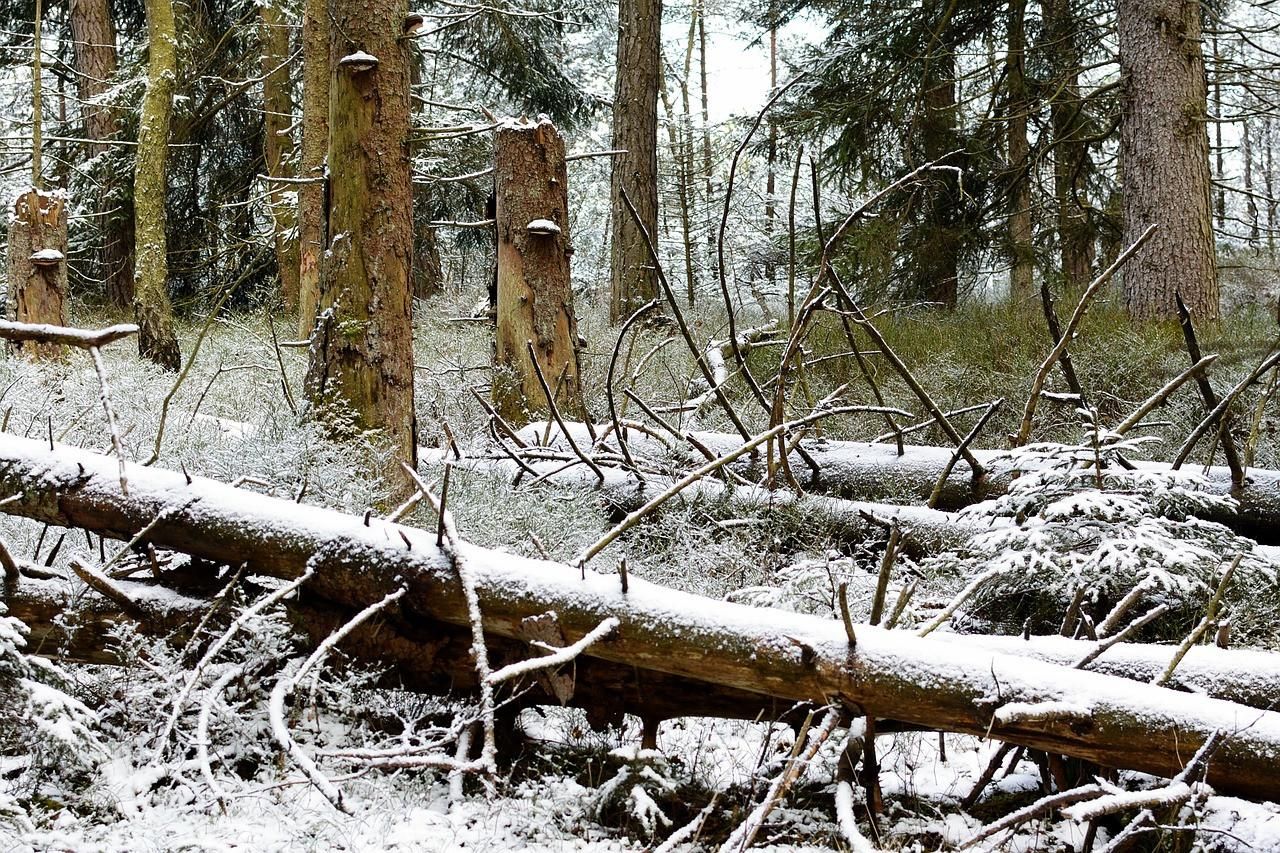
Storms can cause devastating damage in the forest. Not only the high wind speeds play a role.
Whether Wiebke, Kyrill, Xavier or Friederike: storms with wind speeds of over 110 km/h are a problem for forests. But not every forest is equally affected. The extent of the hazard potential at the location depends primarily on the soil conditions and the stand.
Most/majority of trees break at speeds of 150 km/h
During strong storms and hurricanes, the trees are either uprooted or they break down. Scientists at the University of Paris-Saclay have found in a study that more than half of the trees break at speeds of 150 km/h - regardless of their biomechanical properties. Age, shape, type, structure and soil conditions seem to play little role in this. "These results correspond to an evolutionary adaptation over time, because wind speeds of more than 150 kilometres per hour are very rare on Earth," said lead author Emmanuel Virot. In other words, it is not worth investing even more energy and material in stability for these organisms, which already have a long life.
Wind throws in unfavourable soil conditions
During a wind throw the tree is uprooted. The soil is an important factor here. In shallow soils with a high sand content (e.g. in mountainous areas) the roots find less support than in deep loamy soils. As a general rule/basically, the more humid, shallow and coarse-grained the soil, the greater the risk of uprooting trees. Persistent rainfall softens the soil and further increases the risk.
The relief is also decisive. The wind blows particularly strong on coasts, edges and hilltops as well as on upper slopes inclined in the main wind direction. In the hilly Bavarian Forest, you can still see the aisles left behind by Kyrill.
Spruces fall particularly frequently
Especially spruces fall victim to storms. In addition to their susceptibility to root rot, one reason for this is the shallow root system, which offers comparatively little support. Pile roots such as pine have a better chance of withstanding a storm.
Spruce was also frequently cultivated in pure stands that were not suitable for the location. This makes them even more susceptible to storms and periods of heat and drought. In view of increasing extreme weather events, the proportion of spruce in German forestry is therefore declining sharply.
Mixed forests have higher resistance
Better protection is provided by staggered mixed stands with several tree species and individuals of different ages. Their resistance increases with the degree of stocking. Conversely, this means that each thinning operation increases the susceptibility to storm damage. Depending on the extent of the measure and the location, it takes years for the stand to restore its resilience.